
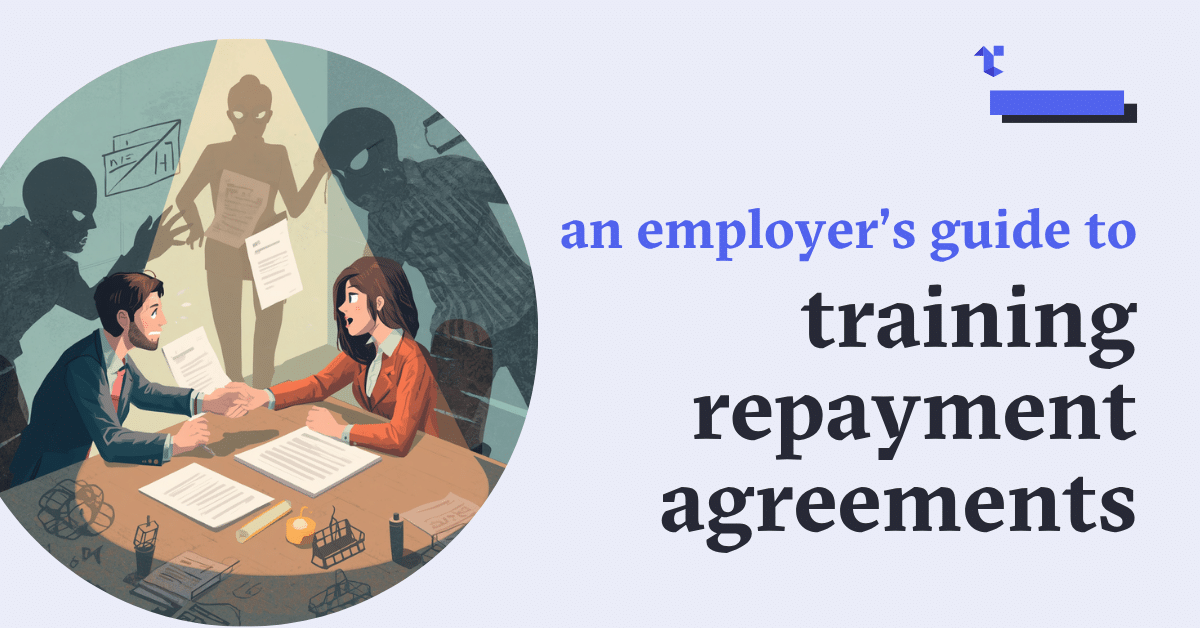
Training Repayment Agreements: An Employer’s Guide
August 7, 2026
Training Repayment Agreements: Where They Hold Up and Where They Get Flagged
A training repayment agreement is a contract provision that requires an employee to reimburse some or all costs of employer-funded education or training if they leave before a set period. Sometimes called a TRAP, sometimes called a stay-or-pay agreement, the concept is legal under federal law and in most states, but its legality in the abstract hides a wide range of outcomes in practice. Some of these agreements survive legal challenges without issue. Others get struck down, investigated, or cited as examples of exactly what regulators are trying to stop. The difference usually comes down to a small set of recognizable factors.
What Is a Training Repayment Agreement?
At its core, a training repayment agreement ties an employee’s continued employment to the repayment of a training cost the employer already covered. The legal theory behind it is straightforward: if an employer makes a real financial investment in an employee’s development, the employer has a legitimate interest in recovering some of that cost if the employee leaves shortly after. Courts have historically accepted that reasoning for specialized, high-value training, which is why these agreements have been common for decades in fields like aviation, engineering, and financial services.
Where Training Repayment Agreements Hold Up
Agreements tend to survive scrutiny when a few conditions are present. The training involved a genuine financial outlay, not just staff time. The credential or certification is portable and useful to the employee beyond their current job, such as tuition for a degree program, a SHRM-CP or PHR certification, a CPA license, or commercial driver’s license training. Participation was voluntary rather than a hidden condition of employment. And the repayment amount reflects the actual documented cost of the training rather than an estimate or a round number picked for deterrent effect. Agreements built on these terms are the ones regulators and courts have generally left alone.
Where the Abuse Gets Caught
The pattern that draws scrutiny looks different. Agreements that require repayment for routine onboarding, job shadowing, or the basic training an employee needs to do the job they were hired for are a common red flag, since that training doesn’t provide value beyond the employer’s own operation. Repayment figures that are flat, inflated, or unrelated to any real cost documentation raise the same concern, particularly when the amount is large enough to make leaving financially unrealistic for the employee. The National Labor Relations Board has brought action against employers using this structure, including a 2024 settlement involving a medical spa that required lower-level employees to repay training costs if they left within two years of being hired. Agreements presented as a non-negotiable condition of hire, rather than something the employee opted into, tend to draw the same kind of attention, since regulators increasingly view that structure as functioning more like a disguised non-compete than a training reimbursement.
How Repayment Amounts Typically Get Structured
Where an agreement holds up, the repayment obligation is usually pro-rated rather than fixed. Instead of requiring the full cost regardless of when the employee leaves, the amount owed shrinks the longer the employee stays, reaching zero at a defined point. An employee who leaves a month after finishing an $8,000 certification owes a different amount than one who leaves after two years. This structure is one of the clearest signals courts and regulators look for when distinguishing a reasonable repayment agreement from a punitive one.
A Regulatory Landscape in Motion
The rules governing these agreements have shifted quickly. California, New York, Colorado, Connecticut, Wyoming, and Indiana have all passed or amended laws restricting stay-or-pay agreements since 2024, and Massachusetts, Nevada, Ohio, Vermont, and Washington have introduced similar legislation. California’s Assembly Bill 692 makes it unlawful, as of January 1, 2026, to include a stay-or-pay obligation in an employment contract unless it meets specific statutory requirements, and New York’s Trapped at Work Act follows a comparable approach. Ohio has not passed restrictions of its own yet, but the direction across other states suggests this is an area where the legal ground is still moving.
Training repayment agreements aren’t inherently good or bad. They’re a tool that works as intended when it’s narrow, transparent, voluntary, and tied to a real and portable credential, and one that tends to attract legal trouble when it’s used to recover the cost of ordinary job training or to make leaving financially punishing. The agreements getting struck down in court and flagged by regulators are rarely subtle about which category they fall into.
share this blog
STAY CONNECTED
Sign up for our newsletter for the latest Tesseon information.
Related Blogs
What our clients are saying about us
Disclaimer: The information provided on this blog page is for general informational purposes only and should not be considered as legal advice. It is advisable to seek professional legal counsel before taking any action based on the content of this page. We do not guarantee the accuracy or completeness of the information provided, and we will not be liable for any losses or damages arising from its use. Any reliance on the information provided is solely at your own risk. Consult a qualified attorney for personalized legal advice.